
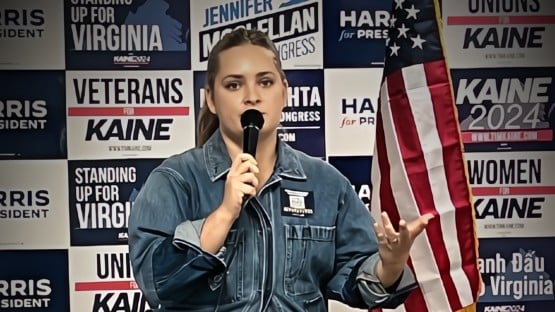
When Lisa Vedernikova Khanna called her Russian immigrant mother a few months ago to tell her that she was running for Congress, mom was, let’s just say, a tad bit disappointed.
“She was hoping that I was pregnant,” said Khanna, who went public last week with that news – that she is expecting, and due in February, meaning, she’s now running for Congress and about to become a first-time mother.
Khanna is in a crowded race for the Democratic Party nomination in Virginia’s First District, where the seat is currently held by a MAGA Republican, Rob Wittman, who is running for a 10th term in Congress.
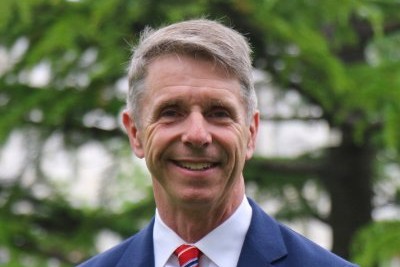
Wittman won his most recent re-election run by a healthy 12.8-point margin, but the district was tighter at the top of the ticket, going to Donald Trump by just five points in 2024, suggesting Democrats are at least within shouting distance with the right candidate.
Wittman will be running next year into a stiff headwind, with Trump seriously underwater in the polls, with voters rocked by the vote in July to pass legislation that will gut healthcare, with inflation still a serious issue for consumers, and the administration creating civil unrest out of the thin air with its draconian policies on immigration.
Wittman has been lockstep with Trump on all of the above, which will make his run in the 2026 midterms a challenge.
The challenge for Khanna will be balancing full-time campaigning with the final three months of pregnancy, then having to skip out as much as possible on the post-natal leave as things get going hot and heavy heading into the June party primary.
“The theme of this year is, I’m doing it all,” said Khanna, whose lived experience as a soon-to-be-mother running for Congress is shaping her policy priorities.
“To me, it’s really important to talk about the pregnancy, not only because I’m six months pregnant, so I’m running out of clothes that can shield it, but also because it is another lived experience that much of the world faces, much of the country faces, and I hear a lot from families across the district and across America that are really struggling with affordability and really struggling with healthcare,” Khanna said in an interview with me on Tuesday.
Earlier in the day, Khanna rolled out her “Ensuring Every Family Can Thrive” plan, which includes proposals for legislation guaranteeing 12 weeks of paid family and medical leave for parents of newborns, protecting reproductive freedom by restoring Roe and safeguarding contraception and IVF, and making childcare affordable by capping expenses at 7 percent of family income and making childcare free for low-income families.
More from the plan is here.
Motivating Khanna is her hardscrabble background – her mother, Masha, emigrated from the former Soviet Union more than 30 years ago; Lisa, born in the U.S., didn’t learn to speak English until she started public school at the age of 6; Sasha, undocumented until finally getting a green card in 2023, juggled jobs as a housekeeper and nanny for years to make ends meet.
“I think we have a lot of members of Congress right now in Washington, D.C., who are so deeply removed from the problems that most Americans have to solve every single day, because they just aren’t their reality, they’re quite wealthy, they’re older. I think it’s really important to elect members of Congress who actually still have that proximity and still have that lived experience to be able to legislate to solve those problems for people,” Khanna said.
Maternal care deserts in the First District, which stretches from the Richmond suburbs to the rural Northern Neck and Middle Peninsula, for instance, are a real problem resulting from the Trump/Wittman Big, Beautiful Bill.
Rising prices from the Trump tariffs are another real problem.
The attacks on public schools, with Trump pledging to eliminate the Department of Education, while also pushing to strip money from federal school funds to fund reimbursement vouchers for wealthy families who send their kids to private schools, another real problem.

The authoritarian approach being taken by the administration to immigration is not just politics to Khanna, who is not only a first-generation American herself, but her husband, Harry, an attorney, is as well.
“ICE was established after 9/11, so when I was a kid, I would already live in fear of my mom getting deported, and that is even more of a stark reality now than it even was when I was a child, which is hard for me to believe,” Khanna said. “I’m really just lucky that my mom got her green card a couple of years ago during the Biden era, but yeah, it’s certainly still a reality to me. We’re seeing people who are Americans get thrown out of the country, right? So, of course, it’s a major thing that I think about.
“I’m going to be really blunt here. I am clearly White, and I think there is a privilege with that, right? Like, my mom is from Eastern Europe, she’s not from Latin America or Central America, and I think that is a different reality.”
Khanna is not as far removed from that reality as she’s letting on there.
She would concede later in our interview that she discussed even bringing up her mother’s status in her bio, because doing so brings to light her own – as the U.S.-born daughter of an undocumented immigrant, against a backdrop where birthright citizenship is under attack from the nativist Trumpers.
Birthright citizenship “is a profoundly American, philosophically American concept, that if you’re born here, you’re as American as someone who came over on the Mayflower,” said Khanna, who admits to worrying about what Trump’s attacks on birthright citizenship mean “for those of us who are already here and are American, and what it will look like to have the fight at the Supreme Court level.”
And what it will mean to her unborn daughter, who is about to be a second-generation American, on both sides.
At least that call went well for Lisa Khanna.
My mom is very excited to be a grandmother. She has been already trying to figure out what the pinkest outfit that she can buy for my daughter will be,” Khanna said.